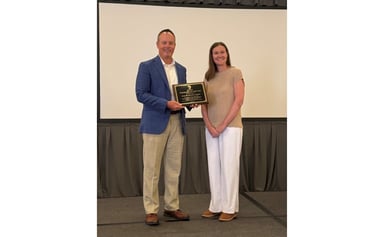
Lindsay is a Florida Bar Board Certified Construction attorney and the Managing Attorney of our Tampa office. As a member of our firm's Professional Liability Department, the focus of her practice is construction defect litigation, architect and engineer defense and general professional liability defense. In this role, Lindsay provides counsel to general contractors, subcontractors, manufacturers, suppliers, architects and engineers in claims brought against them in a variety of construction projects and disputes, both individually and through insurance carriers.
Additionally, Lindsay is well-versed in the practice of pursuing affirmative claims against subcontractors and sub-subcontractors when appropriate, including pursuing tenders and additional insured obligations. Further, Lindsay assists clients through pre-suit investigations, mediations and arbitrations when appropriate. Lindsay is also experienced in handling condominium association claims, and directors' and officers' claims for real estate agents, brokers and appraisers.
In addition, Lindsay is also a former member of the firm's Executive Committee Advisory Council, a distinguished group of firm leaders whose purpose is to enhance the communication between the Executive Committee and younger members of the firm's professional ranks, including associates, special counsel and junior shareholders.
Outside of her law practice, Lindsay is an active participant in various programs with local pet rescue groups in the Tampa Bay Area, where she works with animal rescues and serves as a foster caretaker for rescued dogs in transition, until they find adoptive homes.
Thought Leadership
Case Law Alerts
Florida Courts Reaffirm Damages Must Be Calculated as of Date of Breach in Construction Defect Cases
October 1, 2025
It has been well-settled in Florida that the proper measure of damages for a breach of contract claim is calculated as of the date of the breach. In terms of a construction defect claim, it is the date the construction defect occurred. Yet, we routinely see plaintiffs including significant markups for recent market trends. There are two recent Florida cases reiterating this standard and the consequences of failing to present proper evidence in compliance with this standard. In Bandklayder Dev., LLC v. Saba, the plaintiff claimed construction defects within a newly constructed single-family home. At trial, the plaintiff presented damages calculations from their expert as of the date of their expert’s 2022 report. The expert presented testimony that damages totaled $323,000 as of the date of his report, and that construction costs had increased by 35% as of the May 2023 trial. The plaintiff was awarded $425,000; however, this was reversed on appeal. The Florida Third District Court of Appeals highlighted that the proper measure of damages was the date of the breach, which was 2018, and that “fluctuations in value after the breach do not affect the non-breaching party’s recovery.” Because the plaintiff had failed to present damages as of the date of the claimed breach and because that failure was of their own doing, not of judicial error, the entire verdict was reversed, and the case was remanded with directions to enter judgment for the defendant. Similarly, in Vuletic Group, LLC v. Malkin, a contractor performed work at the homeowners’ property in 2018, which lead to claims of construction defects. At a 2023 bench trial, the homeowners presented evidence of damages from pricing in September 2022. Based thereon, they were awarded almost $500,000. However, again, on appeal this award was reversed. The Appellate Court cited the Florida Supreme Court in holding that: “Damages for a breach of contract should be measured as of the date of the breach. Fluctuations in value after the breach do not affect the non-breaching party’s recovery.” Grossman Holdings Ltd. v. Hourihan, 414 So. 2d 1037, 1040 (Fla. 1982). Yet again, the homeowners failed to present any evidence of the damages as of the date of the claimed breach of contract and, instead, relied on damages calculated years after the breach. Therefore, the homeowners did not meet their burden of proof for their claim, and the case was remanded for entry of judgment in favor of the contractor. Case Law Alerts, 4th Quarter, October 2025 is prepared by Marshall Dennehey to provide information on recent developments of interest to our readers. This publication is not intended to provide legal advice for a specific situation or to create an attorney-client relationship. Copyright © 2025 Marshall Dennehey, all rights reserved. This article may not be reprinted without the express written permission of our firm.
Case Law Alerts
General Contract May Be Entitled to Award of Attorneys’ Fees Against Subcontractor, Despite Jury’s Apportionment of Damages
April 1, 2025
For construction defect litigation, many times we are called into action to defend a subcontractor who has been included as a third party to the primary dispute between an owner and a general contractor. Through the use of third-party complaints, general contractors are consistently including their implicated subcontractors within the primary litigation with the owner in an effort to “pass-through” any determined liability to its subs. An interesting issue that was recently brought up on appeal was whether a general contractor is entitled to an award of attorneys’ fees against its subcontractor based on contractual prevailing party language if the jury apportions a greater percentage of damages to the general contractor rather than the implicated subcontractor. In Babin Builders and Development Inc. v. Quinones, the trial court rejected the general contractors’ motion for attorneys’ fees against its stucco subcontractor because the jury had apportioned 60% of damages to the general contractor and 40% of damages to the stucco subcontractor. Therefore, the trial court determined that the general contractor was not the prevailing party and was not entitled to attorneys’ fees. On appeal, Florida’s First District Court of Appeal reversed the trial court’s ruling. The appellate court, instead, focused on the third-party claims asserted by the general contractor and whether there was a finding of breach of contract. It was determined that the jury did issue a finding for both breach of contract and violation of building code counts on behalf of the stucco subcontractor and, further, there was no finding that the general contractor contributed to these breaches. Therefore, despite a greater percentage of damages being allocated to the general contractor, that was not the controlling factor. Instead, the issue of attorneys’ fees was limited to the third-party claims only. Because the general contractor prevailed in the breach of contract and building code violations claims, the District Court reversed the trial court’s order and remanded the matter for an entry of attorneys’ fees incurred on the third-party claims only. It is important to pay attention to such nuances in interpretation of contract language, including attorneys’ fees provisions in considering risks and exposure. Case Law Alerts, 2nd Quarter, April 2025 is prepared by Marshall Dennehey to provide information on recent developments of interest to our readers. This publication is not intended to provide legal advice for a specific situation or to create an attorney-client relationship. Copyright © 2024 Marshall Dennehey, all rights reserved. This article may not be reprinted without the express written permission of our firm.