Defense Digest
On the Pulse…Other Notable Achievements
Defense Digest, Vol. 29, No. 1, March 2023
March 1, 2023
Marshall Dennehey Announces 2023 Shareholder Class - Largest in Firm’s 60-Year History
Marshall Dennehey is pleased to announce that 20 attorneys, 12 men and eight women, have been elevated to shareholder, effective January 1, 2023. The class is the largest in the firm’s 60-year history and all but one were previously associates of the firm. These new shareholders represent the firm’s four core departments – Casualty, Professional Liability, Health Care, and Workers’ Compensation – and come from 12 of the firm’s 19 regional offices. They are:
Robert J. Aldrich, III, Health Care Department
Jillian L. Dinehart, Casualty Department
Daniel Dolente, Health Care Department
Benjamin K. Durstein, Workers’ Compensation
Adam Fogarty, Casualty Department
Melanie J. Foreman, Casualty Department
G. Michael Garcia, II, Casualty Department
Andrew C. Goldstein, Casualty Department
Brad E. Haas, Casualty Department
Kimberly House, Casualty Department
Sara W. Mazzolla, Casualty Department
Michael S. Miller, Jr., Casualty Department
Nadia E. Niazi, Casualty Department
Lauren E. Purcell, Casualty Department
Josie A. Scanlan, Casualty Department
Kelly Scifres, Workers’ Compensation Department
Mark Volpi, Casualty Department (formerly Special Counsel)
Christian A. Weimann, Casualty Department
Robert E. Williams, Casualty Department
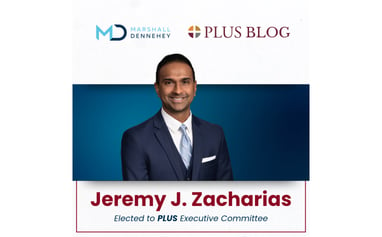
Jeremy J. Zacharias, RPLU, Professional Liability
RECOGNITION
Marshall Dennehey Named Among 2022 Most Recommended Law Firms by BTI Consulting Group
BTI Consulting Group, the leading provider of strategic market research to the legal community, has recognized Marshall Dennehey as a law firm that top legal decision makers frequently recommend. In its report, BTI Most Recommended Law Firms 2022, Marshall Dennehey is among 77 firms that are frequently recommended by corporate counsel. “These firms separate themselves by exceeding client expectations, earning the coveted unprompted client recommendation,” stated the BTI report.
BTI Most Recommended Law Firms 2022 draws on data collected in BTI’s ongoing Annual Survey of General Counsel, which this year included more than 340 in-depth telephone interviews with GCs at organizations with $700 million or more in revenue.
Earlier this year, Marshall Dennehey was named to the BTI Associate Satisfaction A-Listers 2022: BTI Survey of Law Firms Where Associates are Happiest. Among the report’s findings, a large number of women associates named the firm distinguished in activities associates value most in deriving high levels of job satisfaction at law firms. For more information about both reports, please visit www.bticonsulting.com.
Marshall Dennehey Named a 2022 “Tipping the Scales” Firm by the Diversity & Flexibility Alliance
Marshall Dennehey has been named a 2022 “Tipping the Scales” law firm by the Diversity & Flexibility Alliance, as reported in the organization’s New Partner Report. Each year the Alliance compiles data from the nation’s largest and top-grossing law firms to examine the gender breakdown of attorneys promoted to partnership in their U.S. offices.
Marshall Dennehey is one of 57 law firms who have been recognized in the report for having 50% or more women in their 2022 new shareholder class. In announcing the report results, the Alliance stated, “By promoting equal numbers of men and women to Partner, you have signaled your commitment to gender parity and your understanding of the value that women in leadership bring to your firm and your clients.”
Earlier this year, Marshall Dennehey was named to the BTI Associate Satisfaction A-Listers 2022: BTI Survey of Law Firms Where Associates are Happiest. Among the report’s findings, a large number of women associates named the firm distinguished in activities associates value most in deriving high levels of job satisfaction at law firms.
Marshall Dennehey Named a 2023 “Best Law Firm” in Multiple Practice Areas By U.S. News - Best Lawyers®
Marshall Dennehey Warner Coleman & Goggin has been named a “2023 Best Law Firm” in multiple practice areas, both nationally and across numerous regions of the country, by U.S. News – Best Lawyers®. Nationally, the firm ranked in the practice areas of Admiralty & Maritime Law and Insurance Law.
The U.S. News – Best Lawyers® “Best Law Firms” rankings are based on a rigorous evaluation process that includes the collection of client and lawyer evaluations, peer review from leading attorneys in the field, and review of additional information provided by law firms as part of the formal submission process. To be eligible for a 2023 ranking, a law firm must have at least one lawyer recognized in the 27th Edition of The Best Lawyers in America list for that particular location and specialty.
Ranked firms, presented in three tiers, are listed on a national and regional-based scale. Firms that received a tier designation reflect the high level of respect a firm can earn among other leading lawyers and clients in the same communities and practice areas. A description of the selection methodology may be found here: https://bestlawfirms.usnews.com/methodology.aspx.
NATIONAL TIER 1
- Admiralty & Maritime Law
NATIONAL TIER 3
- Insurance Law
METROPOLITAN TIER 1
- Harrisburg: Litigation – Insurance; Personal Injury Litigation – Defendants
- Jacksonville: Construction Law; Litigation – Construction; Professional Malpractice Law - Defendants
- New Jersey: Legal Malpractice Law – Defendants; Personal Injury Litigation – Defendants; Professional Malpractice Law – Defendants
- New York City: Admiralty & Maritime Law
- Philadelphia: Personal Injury Litigation - Defendants;
- Pittsburgh: Legal Malpractice Law – Defendants; Medical Malpractice Law – Defendants; Personal Injury Litigation – Defendants; Product Liability Litigation – Defendants
METROPOLITAN TIER 2
- Cleveland: Insurance Law; Litigation – Health Care; Medical Malpractice Law – Defendants
- Harrisburg: Workers’ Compensation Law – Employers
- Jacksonville: Commercial Litigation; Personal Injury Litigation – Defendants
- Philadelphia: Civil Rights Law; Commercial Litigation
- Pittsburgh: Workers’ Compensation Law – Employers
- Tampa: Personal Injury Litigation – Defendants
METROPOLITAN TIER 3
- Delaware: Product Liability Litigation – Defendants
- Pittsburgh: Litigation – Health Care
- Tampa: Commercial Litigation
SEMINARS
Robert Aldrich (Scranton, PA) presented “Hot Topics in Healthcare” at the Pennsylvania Association of Health Care Risk Management (PAHCRM) conference.
Brigid Alford (Harrisburg, PA) was the moderator and a featured speaker at the Pennsylvania Bar Institute’s “Settlement Strategies and Tips 2022” webinar. Other panelists included Chief Magistrate Judge Karoline Mehalchick from the U.S. District Court for the Middle District of Pennsylvania, and Magistrate Judge Lisa Lenihan from the U.S. District Court for the Western District of Pennsylvania. The seminar drew more than 160 attendees from throughout the state.
Kimberly Berman (Fort Lauderdale, FL) co-presented “Insurer Malpractice Claims Against Defense Counsel: Recognizing, Defending, and Preventing Potential Claims.” This webinar guided insurance defense counsel through the increasingly important topic of insurer claims against defense counsel for legal malpractice committed while defending the insured. The program reviewed common errors, whether a cause of action exists and who may assert it, how liability is established, whether and how work restrictions and counsel guidelines imposed on defense counsel affect liability, how damages are proved, and whether and how the attorney-client privilege or work product protection of the insured affects the case. Kimberly also moderated a panel titled “Brief Writing for the Third DCA” at the Florida Bar’s Appellate Practice’s Practicing Before the Florida Third District Court of Appeal 2022 CLE Seminar.
Christopher Block (Roseland, NJ) presented “Mastering the Professional Malpractice Mediation” at the Professional Liability Defense Federation’s (PLDF) annual meeting in Chicago.
Josh Byrne (Philadelphia, PA) joined a Pennsylvania Bar Institute panel presentation, “Essential Ethics 2022,” focusing on email privacy and security, ethical challenges when lawyers change jobs, and fundamentals of the Pennsylvania Disciplinary Process. Josh also participated in the Dauphin County Bar Association’s Member Benefit Compliance Session. Josh co-presented the ethics portion titled “PBA Malpractice Avoidance.”
Samuel Cohen (Philadelphia, PA) spoke on a panel at the Alternative & Direct Investment Securities Association trade conference in Las Vegas. The panel was titled “Hiring with Caution: How One Bad Apple Can Spoil Your Business.”
Christopher Conrad (Harrisburg, PA) presented “Safe Schools and Bullying” at the Pennsylvania Bar Institute’s Exceptional Children Conference. Christopher also co-presented “Special Education Litigation: Best Practices for Avoiding Liability, and Strategies for a Successful Defense” at the Professional Liability Defense Federation’s (PLDF) annual meeting in Chicago.
John Deasy (Pittsburgh, PA) recently presented “Defending Roller Skating Claims” at a chapter event for the Roller Skating Association in Pittsburgh.
Angela DeMary (Mount Laurel, NJ) participated on a panel at the 33rd Annual New Jersey Workers’ Compensation Bench Bar Conference Moving Forward Together in a Time of Change. Angela’s topic was “Diversity, Equity, Inclusion & the Elimination of Bias in Workers’ Compensation – Why This Matters to You and Your Clients to Achieve the Best Possible Outcome.”
Brooks Foland (Harrisburg, PA) led a practical and interactive Pennsylvania Bar Institute CLE program along with a distinguished panel of ADR professionals titled “Using ADR for Your Practice,” which focused on ADR and Mediation. Brooks also co-moderated the webinar “In the Zoom: Ins and Outs of Remote Mediation” for the Dauphin County Bar Association.
Melanie Foreman (Philadelphia, PA) spoke at the Claims X Change annual conference. She joined a panel to discuss “Three’s Company: Navigating Claims Management Within the Parameters of the Tripartite Relationship.”
Janes Hanratty (Jacksonville, FL) presented “Fresh Approaches to Enhance the Effectiveness and Productivity of Mediations.” Presented at the Jacksonville Bar Association Mediators and Trial Lawyers CLE Forum, Jim and fellow panelists discussed fresh approaches to enhance the effectiveness and productivity of mediations.
John Hare (Philadelphia, PA) spoke at the 2022 Convention of the Defense Research Institute. John addressed the history and notable decisions of the Pennsylvania Supreme Court. John also spoke at the 2022 Pennsylvania Governor’s Office of General Counsel University, the yearly training program for attorneys in the executive branch of state government. There were more than 500 live attendees. John spoke at the invitation of the Pennsylvania Supreme Court and discussed the Court’s functions and notable decisions.
Mark Kozlowski (Scranton, PA) presented “Employment Law Basics – The Basis of OSHA, FLSA, ADA & More,” as the final presentation in an HR 101 Series for the Northeast Pennsylvania Chapter of the Society for Human Resource Management.
Mary Kate McGrath and Adam Fulginiti (Philadelphia, PA) gave a Telehealth Presentation at the Pennsylvania Association of Health Care Risk Management (PAHCRM) conference.
Harold Moroknek (Westchester, NY) presented at the recent Auto Haulers Association Fall Expo in Orlando. His topic was “Where Are You Leaking? Pain Points and Missteps: Things That Cost a Motor Carrier Unnecessary Defense and Indemnity Dollars.”
A.C. Nash (Fort Lauderdale, FL) presented “Talkin’ Bout My Generations” at the RIMS, Broward County Chapter meeting.
Tony Natale (Philadelphia, PA) recently sat down with AM Best’s Insurance Law Podcast to discuss workers’ compensation fraud. You can listen to the podcast here: https://lnkd.in/eTMvMkVe.
Tony Natale and Robin Romano (Philadelphia, PA) were co-presenters at last year’s Philly I-Day conference. Their session, “Hot Topics in Worker’s Comp and Litigation Trends,” focused on trends and case law that are making waves in Pennsylvania workers’ compensation litigation, including unreasonable contest, discharge from employment issues within a workers’ compensation case, head injuries with post-concussion syndrome, and specific loss and extension to full body. Robin and Tony analyzed the impact of these cases on future similar litigation and provided tips for mitigating exposures and liabilities from a risk management perspective. The presentation was attended by local insurance, claims and legal professionals.
Jeff Rapattoni (Mount Laurel, NJ) participated in various sessions at the International Association of Special Investigation Units (IASIU) conference. In “The Management of Brand Protection,” Jeff joined a panel that explored current risks in investigative insurance fraud while balancing the importance of protecting a company’s brand. The use of desk investigations, pass through claims, post-COVID major case, and best practices were explored. Other topics included avoiding bad faith, proper statement techniques, and technology integration between claims and SIU. Jeff also co-presented “Legal Update: Emerging Legal and Legislative Trends in Fraud Fighting,” where a panel of legal experts involved in insurance fraud defense discussed current and emerging legal and legislative trends in the fight against fraud. Finally, he presented an Ethics session focused on investigator ethics, and heard comments and critiques on current case law impacting the SIU and how it relates to the ethical investigation of insurance fraud moving forward.
Suzanne Utke (Philadelphia, PA) taught a course, “Medical Legal Issues for Physicians Assistants,” for Thomas Jefferson University’s Physicians Assistant program. The class was attended by more than 110 students. As an adjunct professor, Suzanne has taught this course for more than 20 years.
Jeremy Zacharias (Mount Laurel, NJ) was a panelist at the Rutgers School of Law’s Professionalism Seminar. This seminar is offered twice a year, and Jeremy is a recurring panelist. He discussed the defense of ethics grievances and the RPCs in the state of New Jersey. The audience included first year law students learning about the Rules of Professional Conduct, and the panel included a federal judge and an attorney from the Public Defender’s Office. Jeremy discussed the importance of the Rules of Professional Conduct in daily practice as well as applications of the Rules of Professional Conduct in practical examples.
Jeremy also presented at an all-day CLE for the New Jersey State Bar Association titled “Commercial Real Estate Transactions: from Fist Bump to Closing.” Jeremy’s section related to ethical considerations pertaining to commercial real estate and the new age of cannabis litigation and the use of commercial space for cannabis dispensaries. Jeremy’s topic focused on the Rules of Professional Conduct and the various duties to disclose certain information during real estate transactions in a commercial setting and duties to third parties relying on an attorney’s advice.
Lary Zucker (Mount Laurel, NJ), Alicia Caridi and Sara Mazzolla (Roseland, NK) made presentations at the International Association of Amusement Parks & Attractions (IAAPA) annual Conference. Together, they presented the annual Legal Roundtable. Larry also presented “IALDA Game Show” and “New Jersey Ride Regulations and ASTM.”
OTHER NEWS
Melanie Foreman (Philadelphia, pa) has been elected to the Board of Trustees of the Philadelphia Bar Foundation. She will serve a three-year term, effective January 2023.
Robert Williams (Jacksonville, FL) served as Master of Ceremony for the first of the Inn year meeting as current president for a local chapter of the American Inns of Court held in Jacksonville, Florida. In attendance was Judge Nordby, First District Court of Appeal of Florida, as guest speaker, as well as two Judges of Workers’ Compensation’ Claims.
Josh Byrne (Philadelphia, pa) was quoted in The Legal Intelligencer article, “ ‘They’ll Get Theirs’: Attorneys Strategize When Depositions Get Heated.” You can read the article here: https://www.law.com/thelegalintelligencer/2023/01/13/theyll-get-theirs-attorneys-strategize-when-depositions-get-heated/
Michael Packer (Fort Lauderdale, FL) was quoted in the Insurance Law Journal article, “New Florida Law Makes Joint Settlement Offers ‘Legit’ Buy May Not Go Far Enough.” You can read the article here: https://www.insurancejournal.com/news/southeast/2023/01/06/701949.htm
PUBLISHED ARTICLES
Kimberly Kanoff Berman (Fort Lauderdale, FL) co-authored “A Not-So-Little Problem with Precedent: Intra-District Conflict in Florida District Courts of Appeal.” This article appeared in January/February 2023 edition of Florida Bar Journal. You can read it here: https://www.floridabar.org/the-florida-bar-journal/a-not-so-little-problem-with-precedent-intra-district-conflict-in-florida-district-courts-of-appeal/#u6daa
Josh Byrne (Philadelphia, PA) co-authored “Settle and Sue Your Lawyer: The Muhammad Doctrine Under Fire,” which was published in the January 2023 issue of Pennsylvania Bar Association Quarterly. You can read the article here: https://marshalldennehey.com/articles/settle-and-sue-your-lawyer-muhammad-doctrine-under-fire. Josh’s article “What Is Worse Than Hiding Your Head in the Sand? A Few Examples” was published in The Legal Intelligencer on November 18, 2022. You can read the article here: https://marshalldennehey.com/articles/what-worse-hiding-your-head-sand-few-examples
Jillian Dinehart (Cleveland) discusses municipalities’ rights and liabilities in weapons and ordnance legislation in the December issue of Cleveland Metropolitan Bar Journal, the publication of the Cleveland Metropolitan Bar Association. Read now: https://lnkd.in/ehndqCax
Evan Dubow and Alexander Mendez (Fort Lauderdale, FL) discuss a recent lawsuit filed by a luxury car dealership against a major foreign auto manufacturer, which has the potential to significantly change the way cars may be sold throughout Florida. To learn more about The Collection’s fight against Porsche AG’s attempt to transition to a direct-to-consumer sales model, read their article in Auto Dealer Today. You can read their article here: https://marshalldennehey.com/articles/porsche-paving-new-sales-model-or-will-dealerships-still-have-collection-cars
Dana Gittleman’s (Philadelphia, PA) article, “Discovery Rule Still Rules in Legal Malpractice Actions,” was published by PLUS Blog. You can read the article here: https://plusblog.org/2023/01/12/discovery-rule-still-rules-in-legal-malpractice-actions/
Gregory Graham (Pittsburgh, PA) authored the article “Demand for Remote Desktop Access and Cloud Computing Services Necessitates a Refined Approach for Civil Litigation E-Discovery,” appearing in Lawyers Journal, the publication of the Allegheny County Bar Association. In his article, Greg discusses data mapping as a solution for bypassing challenges that cloud computing and remote access services can create for e-discovery. Read the article here: https://marshalldennehey.com/articles/demand-remote-desktop-access-and-cloud-computing-services-necessitates-refined-approach
Brad Haas’s (Pittsburgh) article “Managing Liability for Videoconferencing While Driving” was published on January 3, 2023, by Risk Management. You can read the article here: http://www.rmmagazine.com/articles/article/2023/01/03/managing-liability-for-videoconferencing-while-driving
Ronda O’Donnell (Philadelphia, PA) contributed an article to Pennsylvania Law Weekly. Titled, “Board Takes Aim at Employers’ Rules That Violate National Labor Relations Act.” The article discusses how employers must be mindful when developing, implementing, or enforcing rules or policies that might arguably restrict employees’ speech, particularly when it comes to discussions regarding the terms and conditions of employment and employees’ compensation and wages. Employers who fail to pay attention to these types of prohibitions might, reluctantly, find themselves among those targeted for action by the NLRB.
Michael Salvati’s (Philadelphia PA) article “A Two-Pronged Test Becomes One: Why the Superior Court’s Venue Decision in Hangey Departs from Decades of Prior Precedent” was published in The Pennsylvania Lawyer. You can read the article here: https://assets.marshalldennehey.com/content/uploads/2026/04/O-643-by-M.-Salvati-01-02.2023-The-PA-Lawyer.pdf
Robert Stanko and Andrew Goldstein (Philadelphia, PA) authored the article, “Increase in Crime Forces Local Businesses Into a Catch-22,” that was published in The Legal Intelligencer’s Personal Injury Supplement. You can read the article here: https://marshalldennehey.com/articles/increase-crime-forces-local-businesses-catch-22
Defense Digest, Vol. 29, No. 1, March 2023, is prepared by Marshall Dennehey to provide information on recent legal developments of interest to our readers. This publication is not intended to provide legal advice for a specific situation or to create an attorney-client relationship. ATTORNEY ADVERTISING pursuant to New York RPC 7.1. © 2023 Marshall Dennehey. All Rights Reserved. This article may not be reprinted without the express written permission of our firm. For reprints, contact tamontemuro@mdwcg.com.