
.

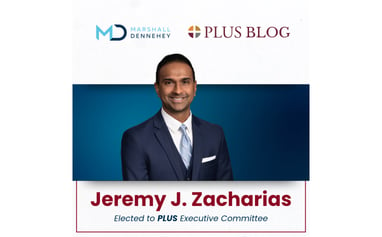
Jeremy J. Zacharias RPLU

Portrait of Jeremy  J.  Zacharias

Jeremy is a member of the Professional Liability Department where he represents and defends attorneys, accountants, insurance producers, corporate directors and officers, and financial institutions, among other clients.

Jeremy handles various cases involving insurance agents and brokers liability. In connection with the same, Jeremy defends clients facing allegations of professional negligence, breach of fiduciary duty and breach of contract and routinely works with clients in an advisory capacity regarding best practices in consulting with insureds. In connection with handling insurance agents and brokers liability claims, Jeremy frequently publishes materials with the Professional Liability Underwriting Society (PLUS) through the PLUS Blog and offers various risk management tips through the PLUS podcast series.

Jeremy also represents clients in privacy and data breach matters and handles cases involving intellectual property, copyright and trademark infringement, as well as trade secret, trade dress technology and media-related litigation.

He is an active member of PLUS where he currently serves on the Board of Trustees. He is an alumnus of its Leadership and Mentoring Program (LAMP). Through PLUS, Jeremy achieved his Registered Professional Liability Underwriting (RPLU) Certification. He also serves on the PLUS Mid Atlantic Chapter Committee.

Jeremy graduated magna cum laude from Drexel University's LeBow College of Business. He earned his juris doctor from Rutgers University School of Law, graduating cum laude and in the top 15 percent of his class.

He is an active member of the New Jersey State, Camden County, and Burlington County Bar Associations. He is a frequent guest speaker at his alma mater, Rutgers University School of Law and at Drexel University’s LeBow College of Business, on topics including professionalism and career development. He is also active in the Knights of Columbus organization in his community. 

Jeremy is admitted to the bars of the states of New Jersey and Pennsylvania and is admitted to practice in federal court in both the District of New Jersey and the Eastern District of Pennsylvania.

    • Rutgers Law School (J.D., cum laude, 2014)
    • Drexel University (B.S., magna cum laude, 2011)
    • New Jersey, 2014
    • Pennsylvania, 2014
    • U.S. District Court District of New Jersey, 2014
    • U.S. District Court Eastern District of Pennsylvania, 2023
    • The Best Lawyers: Ones to Watch®, Commercial Litigation (2021-2025)
      The Best Lawyers list is issued by Woodward & White. A description of the selection methodology can be found here. No aspect of this advertisement has been approved by the Supreme Court of New Jersey.
    • New Jersey Super Lawyer Rising Stars (2024)
      The Super Lawyers list is issued by Thomson Reuters. A description of the selection methodology can be found here. No aspect of this advertisement has been approved by the Supreme Court of New Jersey.
    • PLUS Emerging Leader Award, from the Professional Liability Underwriting Society (2021)
    • Professional Liability Underwriting Society
    • Burlington County Bar Association
    • Camden County Bar Association
    • New Jersey State Bar Association
    • PLUS Podcast: Insurance Agent E&O - Top Ten Tips for Risk Management Series, Episode 3, October 13, 2025
    • PLUS Podcast: Insurance Agent E&O - Top Ten Tips for Risk Management Series, Episode 2, August 7, 2025
    • Solving Problems in Commercial Real Estate Transactions - 21st Century Ethical Issues in Commercial Real Estate Transactions, NJICLE Seminar, July 17, 2025
    • PLUS Podcast: Insurance Agent E&O - Top Ten Tips for Risk Management Series, Episode 1, June 9, 2025
    • From Interview to Offer: Navigating Clerkships, Networking & Career Success - Panelist, Rutgers Law School Minority Student Program, February 12, 2025
    • Solving Problems in Commercial Real Estate Transactions - 21st Century Ethical Issues in Commercial Real Estate Transactions, NJICLE Seminar, July 18, 2024
    • The Defense of Appellate Counsel in Legal Malpractice Actions, Client Webinar, June 4, 2024
    • Commercial Real Estate Transactions: From Handshake to Closing - Ethical Considerations with Commercial Real Estate Transactions, NJICLE Seminar, September 8, 2023
    • Strategic Approaches to Handling Lost Profit Claims Under New Jersey's New Business Rule, Client Webinar, September 7, 2023
    • Virtual Jury Trials in New Jersey: The Good, The Bad and The Ugly, Client Webinar, March 25, 2022
    • Jeremy represented an indigent defendant facing prison time for violating a final restraining order for contacting his ex-girlfriend in Gloucester County, New Jersey. Jeremy was able to obtain a dismissal of this case since his client had no prior violations and was able to maintain steady employment. 

Results

Thought Leadership

Legal Updates for Lawyers' Professional Liability

Appellate Division Affirms Dismissal of Legal Malpractice Counterclaim Against Martin Law Firm

July 29, 2026

In Martin v. Loury, 2026 N.J. Super. Unpub. LEXIS 1617 (App. Div. July 15, 2026), Martin Law Firm represented Kirk Loury in an employment matter Mr. Loury filed against his former employer, Concord Equity Group Advisors LLC (“Concord”). The allegations included, among other things, that Loury was not fairly compensated for his employment with Concord. After a bench trial finding in Loury’s favor, the Appellate Division remanded this matter in February 2016 for a second trial. During the second trial, Concord CEO, Lee Argush, testified to lower compensation estimate than first trial. On remand, the second trial judge awarded Mr. Loury the same damages as the first judge, finding Mr. Argush not credible. After the findings during the second trial, Martin Law Firm filed an action against Mr. Loury to recover legal fees and costs of representing Mr. Loury in a second bench trial and Mr. Loury filed a counterclaim against Martin Law Firm for legal malpractice, alleging he should have received an even higher award in the second bench trial. In this allegation, Mr. Loury, through his expert, claimed that Martin Law Firm should have recalled Mr. Loury to the stand to rebut Mr. Argush’s testimony to allege an alternative theory of damages. Mr. Loury’s expert admitted that the second judge already rejected Mr. Argush's theory and accepted Loury's damages theory. The trial court barred Mr. Loury’s expert and dismissed Loury's counterclaim with prejudice before convening the collection trial, and the jury ruled in Martin Law Firm’s favor. Mr. Loury appealed the trial court's pretrial rulings barring his liability expert from testifying in support of his legal malpractice counterclaim, denying his motion for summary judgment on that counterclaim, and denying his motion to amend his counterclaim by adding attorney Joseph A. Martin as a codefendant. In affirming the trial court’s decision, the Appellate Division held that the trial court properly excluded Loury’s expert testimony in the counterclaim against Martin Law Firm because the expert could not explain how calling Loury as a rebuttal witness would have increased damages when the second judge already rejected Mr. Argush's testimony and accepted Loury's damages theory, making the expert’s causation opinion speculative. The Appellate Division also held that the trial court properly denied Mr. Loury's summary judgment motion on his malpractice counterclaim because reasonable minds could differ on whether Mr. Martin's alleged failures would have changed the second judge's damages award, given the judge already found Mr. Argush not credible, creating genuine factual disputes precluding summary judgment. Also, the Appellate Division held that the trial court properly denied Loury's May 2023 motion to add Joseph Martin individually because the statute of limitations expired in February 2022, six years after the 2016 appellate remand when Mr. Loury incurred new legal costs, and relation back did not apply because Mr. Loury knew Mr. Martin's identity throughout and strategically chose to sue only Martin Law Firm in his 2019 counterclaim.

Legal Updates for Lawyers' Professional Liability

New Jersey Appellate Division Affirms Exclusion of Legal Malpractice Expert as Impermissible Net Opinion

July 23, 2026

Jack Slimm and Jeremy Zacharias obtained a favorable decision on behalf of their client in a case centering on the admissibility of expert testimony in legal malpractice actions. In Martin v. Loury, the New Jersey Appellate Division affirmed the exclusion of a plaintiff's legal malpractice expert, holding that the expert's opinions on causation and damages were too speculative to support the malpractice claim. The legal malpractice action arose from an underlying employment dispute involving claims for damages stemming from the breach of an employment agreement. The plaintiff alleged that defense counsel committed malpractice during a second trial by failing to recall the plaintiff as a rebuttal witness after the employer's CEO testified. According to the plaintiff's expert, additional rebuttal testimony would have bolstered the plaintiff's damages claims and led to a more favorable result. Both the trial court and the Appellate Division rejected that theory. The courts found that the expert could not explain how the proposed rebuttal testimony would have altered the outcome of the underlying case or resulted in any additional recoverable damages. Notably, the trial judge in the underlying employment matter had already rejected the CEO's testimony as not credible and had accepted the damages analysis advanced by the plaintiff. The court had also determined that the amount of damages was not genuinely disputed. As a result, the expert's opinion that additional rebuttal testimony would have produced a better outcome was unsupported by the record and based on speculation rather than evidence. The Appellate Division agreed that neither the plaintiff nor the expert could identify any actual damages attributable to the alleged malpractice or demonstrate the required element of proximate causation. The court further upheld the trial court's application of New Jersey's net opinion doctrine, finding that the expert failed to provide the necessary "why and wherefore" supporting his conclusion that the attorney's conduct caused a compensable loss. Because the opinions rested on unquantified possibilities rather than demonstrable facts, they were inadmissible. Key Takeaway for Legal Malpractice Defendants For attorneys and firms defending legal malpractice claims, Martin v. Loury underscores the importance of closely scrutinizing an opponent's expert report on the critical elements of proximate causation and damages. The decision demonstrates that a malpractice claim cannot survive where an expert merely speculates that different litigation tactics might have produced a better result. Instead, the plaintiff must present admissible expert testimony grounded in the record that explains how the alleged attorney error probably changed the outcome of the underlying matter and resulted in measurable damages.

Firm Highlights

Thought Leadership

Pennsylvania HB 2307: Special Education Contingency Fund Reform

Pennsylvania school districts and school law attorneys are aware of the increasing cost of special education services. In an effort to address this growing squeeze on school district budgets, a bi-partisan group of Pennsylvania House Representatives introduced House Bill 2307. The bill is a special education funding measure intended to reform Pennsylvania's reimbursement system for extraordinarily high-cost special education students. As written, HB 2307 would increase funding dedicated to Pennsylvania's Extraordinary Special Education Program Expenses reimbursement program. Beginning with the 2026-27 school year, the bill would increase the set-aside from 1% to 2% of the annual Special Education appropriation. The increased funding is aimed at assisting school districts and charter schools address the costs of serving students whose needs generate exceptionally high special education expenses. The proposal specifically targets situations involving students whose annual special education costs exceed the state's highest cost threshold and represent a significant burden on a district's special education budget. HB 2307 includes key eligibility requirements such as: 1) extraordinary special education expenses approved by the Secretary of Education; 2) student costs exceeding the state's highest Category 3A threshold; 3) costs representing at least 1% of the district's total special education expenditures; 4) student enrolled in the district for no more than two consecutive school years for the proposed reimbursement category; and 5) application and documentation requirements for districts and charter schools. HB 2307 successfully passed the Pennsylvania House of Representatives on June 16, 2026, by a unanimous vote of 202-0. It was subsequently transmitted to the Senate and was referred to the Senate Education Committee on June 22, 2026, where it currently remains pending. While there is currently no scheduled Senate committee or floor vote publicly listed for HB 2307, the next step would be for the Senate Education Committee to consider the bill and determine whether to report it to the full Senate for consideration. If approved by the committee, the bill would proceed through the Senate's three-consideration process before a final vote. Because the General Assembly is still within the 2025-26 legislative session, the bill remains eligible for action during the remainder of the session. However, absent committee action, it will not become law before the start of the 2026-27 school year. If enacted, HB 2307 could have several important effects: Greater financial stability for districts serving students with exceptionally expensive educational and related-service needs. Increased reimbursement opportunities for high-cost placements, specialized transportation, intensive behavioral supports, and other extraordinary services. Reduced pressure on local special education budgets, particularly in smaller districts where one or two high-cost students can significantly affect annual expenditures. Potential reduction in litigation and placement disputes driven by financial constraints, although the bill does not alter substantive IDEA rights or district obligations to provide FAPE.

Thought Leadership

U.S. Department of Education Reports to Congress on Disciplinary Removals of Children with Disabilities

In June 2026, the United States Department of Education, through the Office of Special Education and Rehabilitative Services (OSERS), published its “47th Annual Report to Congress on the Implementation of the Individuals with Disabilities Education Act, 2025.” In its report, OSERS provided detailed data and information on the discipline and removal of students from their educational placements, specifically for the school year 2022-2023. To obtain this data, all 50 states, the District of Columbia, the Bureau of Indian Education, Puerto Rico, and other U.S. territories, were asked to report on pre-school and school-aged students, ages 3-21, who were served under IDEA, Part B, and removed from their educational placements for disciplinary reasons during the school year in question. Not all jurisdictions had data available; OSERS’ reporting to Congress was based on the information supplied by the jurisdictions that responded.  First, OSERS examined the total number of served students who were removed to an interim alternative educational setting. From the reporting data, this number totaled 7,204,199 students. Of this total, 11,364 students were removed unilaterally by school personnel for drugs, weapons, or serious bodily injury to themselves or others. These figures reflected the unilateral removal of served students at a rate of 16 per 10,000 students. Of this total, 545 students were removed by a due process hearing officer for likely serious bodily injury, a rate of one per 10,000 students.  Next, OSERS examined data for students who were suspended (in school and out of school) or expelled for more than 10 school days. The total number of students in this category was 7,623,095. Of this total, 65,104 students received out of school suspensions or expulsions, a rate of 85 per 10,000 students. A total of 21,878 students received in school suspensions, a rate of 29 students per 10,000.  OSERS evaluated this particular data and drilled down further, examining the rate of interim removal, expulsion, and suspension per 10,000 students based specifically upon each IDEA disability category. Perhaps not surprisingly, children primarily identified with emotional disturbance were the most affected.    For every 10,000 students who were identified under the category of emotional disturbance, 65 were unilaterally removed to an interim alternative educational setting by school personnel (not the IEP team) for drugs, weapons, or serious bodily injury, and four out of every 10,000 students were removed following a hearing officer finding that there was a substantial likelihood of serious bodily injury to the student or others. By contrast, the ratio of students under each of the other disability categories who were unilaterally removed by school personnel was 25 or less per 10,000 students in each category. No more than two students per 10,000 in each of the other categories were removed by a hearing officer. Other Health Impairment was the second leading category.  For every 10,000 students identified primarily with emotional disturbance, 411 students received out of school suspensions or expulsions of more than 10 days, and 107 of every 10,000 students in this category received in-school suspensions. In comparison, the ratio of students under each of the other disability categories who received out of school suspensions or expulsions of more than 10 days was no more than 172 per 10,000. Students identified in all other disability categories received in-school suspensions at a rate of no more than 57 per 10,000 students. Again, Other Health Impairment was the second leading category. OSERS then examined discipline data with a state-by-state comparison, once more at a ratio of 10,000 students served. The overall data of students who were unilaterally removed to an interim alternative educational setting by school personnel for drugs, weapons, or serious bodily injury showed that removal occurred most frequently in Texas (92 per 10,000 students), Montana (62 per 10,000 students), and Tennessee (42 per 10,000 students). The mean was 12.1.  In Pennsylvania, the rate of removal was 12 out of every 10,000 students, just below the mean.  OSERS also considered, on a state-by-state basis, the number of students who received out-of-school suspensions or expulsions of greater than 10 days. The most significant rate of discipline here occurred in North Carolina (256 per 10,000 students), Missouri (250 per 10,000 students), and South Carolina (250 per 10,000 students).  The mean was 85.83. In Pennsylvania, the rate of discipline was 57 per 10,000 students, well below the mean.  Finally, OSERS evaluated, on a state-by-state comparison, the ratio of students per 10,000 who were identified under the category of emotional disturbance and who received out of school suspensions or expulsions for greater than 10 days. The suspension or expulsion of students with emotional disturbance occurred most often in North Carolina (1,723 per 10,000 students), Missouri (1,127 per 10,000 students), and South Carolina (1,098 per 10,000). The mean was 485.81. In Pennsylvania, the suspension or expulsion of students identified with emotional disturbance occurred at a rate of 260 per 10,000, again well below the mean. Although OSERS did not draw any specific conclusions about the disciplinary data it collected, it is nonetheless evident that students primarily identified with emotional disturbance were removed from their educational placements for disciplinary reasons at a rate much higher than students in any other disability category. Relatively speaking, however, Pennsylvania acquitted itself well in the state-by-state disciplinary data collection.