Jacksonville
Our Jacksonville, Florida, office delivers strategic, well-prepared defense litigation through attorneys who are experienced, practical, and readily accessible. Serving clients throughout northern Florida, our attorneys defend clients in casualty, professional liability, health care and workers' compensation matters.
As a regional office of Marshall Dennehey, the Jacksonville office is backed by the resources of a 500-lawyer firm. It stands ready to assist every client—be they individuals, small businesses, large corporations or insurance carriers—by providing high-quality, result-oriented legal representation that is both innovative and cost-effective.
Thought Leadership
What's Hot in Workers' Comp
Appellate Court Rejects Horizontal Immunity Defense to Company Not Acting as Statutory Subcontractor
August 13, 2026
The First District Court of Appeal held that a property management company was not entitled to horizontal immunity under section 440.10(1)(e), Florida Statutes, in a negligence action brought by an employee of another company working on the property. The claimant was injured while servicing a swimming pool at an apartment complex. His employer had contracted with the property owner to maintain the pool. Following the accident, the claimant received workers' compensation benefits through his employer’s carrier. The claimant subsequently filed a negligence action against the property management company, alleging that it failed to maintain the premises in a reasonably safe condition and failed to warn him of a dangerous condition that caused his injuries. The property management company had been retained by the property owner to maintain the complex in good operating condition and to perform routine maintenance and repair work. The property management company argued that it was immune from suit under section 440.10(1)(e) of Florida’s Workers’ Compensation Law. That provision grants immunity to a subcontractor providing services in conjunction with a contractor on the same project or contract work from civil actions brought by employees of another subcontractor, subject to limited exceptions. According to the property management company, it qualified as a subcontractor working on the same project as the claimant’s employer and was therefore entitled to horizontal immunity. The trial court agreed and entered summary judgment in its favor. On appeal, however, the claimant argued, and the appellate court agreed, that horizontal immunity applies only when a contractor has sublet work arising from a contractual obligation owed to a third party. The court noted that prior decisions consistently held that an entity acting solely on its own behalf as the owner of property, rather than pursuant to a contract with a third party, is not a “contractor” under section 440.10(1), even when it hires other companies to perform work on the property. In Teed, the property management company could not establish that the property owner had a primary contractual obligation to a third party to maintain either the apartment complex or the swimming pool, which it then delegated to the claimant’s employer or the property management company. As a result, the property owner did not qualify as a statutory contractor, and the property management company was not a subcontractor entitled to horizontal immunity under section 440.10(1)(e). The First District therefore reversed the lower court’s ruling and remanded the case for further proceedings on the claimant’s negligence claim.
Insurance Journal
Fla. Workers' Comp Physician Dispensing Ruling Could Produce New Legislative Fight
August 5, 2026
In a significant decision issued on February 25, 2026, the First District Court of Appeal (DCA) ruled in Publix Super Markets, Inc., et al. v. Department of Financial Services, et al., 430 So. 3d 252 (Fla. 1st DCA 2026), that while injured workers have an absolute right to choose their own pharmacy or pharmacist, that right does not extend to physicians who dispense medications directly to their patients. Read Blake's article in Insurance Journal: https://www.insurancejournal.com/news/southeast/2026/08/05/880229.htm.
Results
Secured judgment on the pleadings and final judgment for an insurance carrier in a complex first-party property damage claim involving residential roof and interior damage.
We secured an order granting motion for judgment on the pleadings and final judgment in favor of an insurance carrier in a complex first-party property loss case involving a residential roof and interior damage claim. The carrier initially provided coverage for damage to the insured’s metal porch roof caused by a fallen tree branch. Several months later, however, the plaintiff reported additional damage to the home’s shingle roof and interior, which the carrier denied. In response to the lawsuit, we asserted several affirmative defenses, including that the carrier had properly paid the covered portion of the loss, that the delayed reporting of the additional damage prejudiced the carrier’s ability to investigate the claim, and that policy exclusions applied to the shingle roof and interior damage. The plaintiff failed to file a reply addressing those affirmative defenses. The defense moved for judgment on the pleadings, arguing that the plaintiff had therefore failed to challenge or otherwise avoid the new matters raised by the carrier. The court agreed, granted the motion and entered final judgment in favor of our client.
Summary Judgment Obtained in a Vehicular Accident Case Involving Disputed Liability
We received summary judgment in a vehicular accident case involving disputed liability. Mr. Thurman was the third vehicle in a three-car collision in which the first vehicle admitted fault and was ticketed. Following the accident, the plaintiffs claimed they were in a fourth vehicle and alleged that Mr. Thurman caused the crash. When the claim was denied—and on the eve of the implementation of tort reform—the plaintiffs filed individual lawsuits against Mr. Thurman alone. We subpoenaed the repair shop that serviced Mr. Thurman’s vehicle and obtained records confirming that there was no front-end damage. When the plaintiffs failed to respond to discovery, we prepared motions for summary judgment in both cases. In response, only one plaintiff submitted an affidavit, while Mr. Thurman provided his own affidavit denying the allegations. We argued the motions, demonstrating that the evidence showed the plaintiffs were not involved in the collision and that Mr. Thurman bore no fault. The court ruled in our favor in both cases. Before the orders could be entered, however, the plaintiffs filed notices of voluntary dismissal with prejudice. Before moving for summary judgment, we had served Proposals for Settlement on the plaintiffs and their counsel. After the dismissals, we filed a motion establishing entitlement to attorney’s fees, and the parties ultimately reached an agreement resolving all fees and costs in both cases.
News
106 Marshall Dennehey Attorneys Recognized in the 2027 Editions of The Best Lawyers in America® and the Best Lawyers: Ones to Watch® in America
August 20, 2026
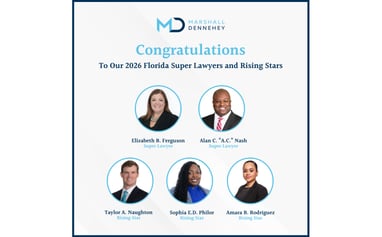
Marshall Dennehey Announces 2026 Florida Super Lawyers & Florida Rising Stars
June 26, 2026
Marshall Dennehey Again Earns Recognition in Distinguished Chambers USA
June 4, 2026