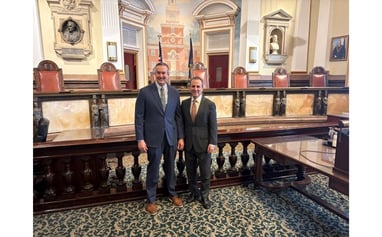
.

Michael is an experienced workers' compensation attorney who focuses his practice on defending employers and insurance carriers in matters related to workers' compensation. He counsels clients on all aspects of workers' compensation claims management to help minimize their exposure. He has successfully defended employers in many industries, including trucking, construction, landscaping, manufacturing, hospitality and assisted living facilities. 

Michael earned his Bachelor of Arts in Political Science from The Pennsylvania State University and his juris doctor from Widener University Delaware Law School. He is admitted to practice in Pennsylvania and New Jersey.

An active member of the legal community, Michael is a member of the Pennsylvania Workers' Compensation Coalition, Brehon Law Society, Philadelphia Bar Association and Judge Alexander F. Barbieri Workers’ Compensation Inn of Court.

    • Widener University Delaware Law School (J.D., 2015)
    • The Pennsylvania State University (B.A., 2011)
    • New Jersey, 2016
    • Pennsylvania, 2016
    • Pennsylvania Super Lawyer Rising Star (2022-2026)
    • Brehon Law Society
    • Judge Alexander F. Barbieri Workers’ Compensation Inn of Court
    • Pennsylvania Workers' Compensation Coalition
    • Philadelphia Bar Association
    • URMIA
    • Caught on Camera: Using Surveillance & Social Media in PA Workers’ Compensation Cases, PBI's Tough Problems in Workers' Compensation 2025, June 12, 2025
    • Unique Workers' Compensation Aspects of Independent Contractors and Traveling Employees, Lorman Education Services webinar, December 16, 2021
    • Workers' Compensation 101, client seminar, August 19, 2020
    • Received a favorable decision where the judge granted our termination petition and denied the claimant’s Petition for Penalties and Petition to Review Utilization Review Determination. The employer had accepted a right middle finger sprain. In prior litigation, the claimant’s review petition seeking to expand this injury was denied. In the pending termination petition, the judge found the claimant not credible with regard to his ongoing complaints. The claimant claimed to be bed bound, and the judge opined that this allegation as a result of a finger sprain was absurd. The penalty petition related to payment of medical bills, and the judge found that, since the medical bills were related to the hand and not the finger, the penalty was denied. He also denied the claimant’s Petition to Review the Utilization Review Determination, finding that more than 185 physical therapy visits were not reasonable for a finger sprain and because the opinions of the reviewer were corroborated by the employer’s expert’s opinion of full recovery.
    • Obtained a decision granting the employer’s termination petition. The claimant had sustained injuries to her low back as a result of a work injury wherein she was struck in her back by a coworker opening a door. The claimant alleged she sustained additional injuries, including multiple disc herniations. After subpoenaing records from various providers, Michael was able to show that the claimant had been in multiple car accidents and had prior injuries to her low back, resulting in treatment lasting up to a few months prior to the work injury. The claimant had denied any prior injuries during her testimony before the workers' compensation judge. The judge found the employer's expert credible and terminated the claimant's benefits.
    • Received a favorable decision in a case involving Claim and Penalty petitions. The claimant alleged cervical injuries requiring surgery. Our medical expert agreed that surgery was required but did not agree to a work injury based on the records obtained following the claimant’s deposition. Though the claimant testified to never having prior injuries or treatment for his neck prior to the injuries, Mike was able to obtain medical records showing treatment for the same complaints two weeks prior to the work injury. The judge denied the Claim and Penalty petitions.
    • Obtained a Decision granting Review and Termination Petitions and denying the claimant’s Review Petition. The claimant fell approximately 20 feet from a ladder and sustained bilateral calcaneal fractures. The employer/insurer issued an NCP accepting bilateral ankle fractures. The defense filed a Termination Petition alleging a full recovery and also filed a Review to amend the description of injury to change the description of injury to bilateral calcaneal fractures. The claimant then filed a Review to amend the description of injury to include traumatic neuropathic pain secondary to bilateral calcaneal fractures, lumbar spine strain, lumbar spine disc injury, and bilateral lumbar radiculopathy. In making his decision, the judge found the defense expert more credible than claimant’s expert.

Results

Favorable Decision Secured in Multi-Million Dollar Workers’ Compensation Matter

We received a favorable decision that saved our client millions of dollars. The claimant filed a claim petition alleging he sustained a left shoulder dislocation, stroke, traumatic brain injury, gait dysfunction, central pain syndrome and post-traumatic seizures as a result of a fall at work. After the claimant fell at work and sustained a left shoulder dislocation, he went to the hospital for the dislocation, was treated and discharged. Four days later he sustained a stroke at home. He had multiple surgeries and was hospitalized for four months. He is severely disabled as a result of the stroke and requires full-time care. The claimant initially alleged he sustained a head injury from the fall at work which caused the stroke. He claimed he was bleeding from his nose and mouth and had a laceration to his forehead. We were able to show that did not occur by presenting fact witnesses who established the claimant fell off one step, never hit his head, was not bleeding from his head or face, only dislocated his shoulder, and was discharged home without issue. Claimant’s counsel then alleged the claimant’s stroke was related to a spike in his high blood pressure that placed him in a hypertensive crisis resulting in the stroke. We showed that the claimant had unregulated high blood pressure before the work injury and that he was released from the hospital with high blood pressure, but not enough to be in hypertensive crisis. The judge agreed with our arguments, finding that the claimant only sustained the agreed-upon shoulder dislocation. Therefore, the claimant was awarded one day of wage loss benefits for the shoulder dislocation. The stroke, traumatic brain injury, gait dysfunction, central pain syndrome, and post traumatic seizures were denied and dismissed. As the claimant is only 48 years old and his compensation rate resulted in $30,000 a year wage loss benefit, wage loss for the rest of his life would likely have been around $1 million. The claimant’s medical costs were going to be much higher as he requires round-the-clock care, which over his lifetime would have cost millions. His hospital bills alone were over $1 million, and claimant’s counsel would have argued for home modifications and vehicle modifications. Instead, the claimant will receive a one-day payment of about $88.

Termination Petition Affirmed before the Workers’ Compensation Appeal Board

We received an opinion from the Workers’ Compensation Appeal Board affirming the decision granting our termination petition. The employer had accepted an “upper back area” injury through a Notice of Compensation Payable. Prior to issuing the NCP, the employer secured an IME, where the doctor ultimately opined that the claimant was fully recovered from a lumbar sprain. The workers’ compensation judge found that the claimant was fully recovered from the work injury based upon the credible opinions of the employer’s medical expert. The claimant appealed, arguing the termination was improper as the IME occurred before the NCP was issued; therefore, the change in condition needed to occur after the NCP. Additionally, the claimant argued the termination was improper as the IME doctor found a different injury than the injury noted on the NCP. The Appeal Board opined that the employer sustained its burden of proof as its expert’s testimony constituted substantial evidence, sufficient in nature to meet its burden of proof. The Appeal Board further found that since the employer was not disputing an injury occurred, it was not attempting to re-litigate whether the claimant sustained a work injury. Rather, it was disputing whether the claimant was still disabled. The Appeal Board further opined that the claimant’s expert evaluated the whole back and that the credible evidence revealed the claimant was fully recovered.

Thought Leadership

Defense Digest

A Costly Mistake

June 1, 2025

Key Points: A workers’ compensation judge is not required to correct a mistakenly-issued Notice of Compensation Payable, but they may correct a mistakenly-issued Notice of Compensation Payable. The court would not overturn a workers’ compensation judge’s refusal to correct a mistakenly-issued Notice of Compensation Payable. The decision to correct a mistakenly-issued Bureau document is in the workers’ compensation judge’s discretion. The Commonwealth Court of Pennsylvania recently issued an opinion finding that, although a workers’ compensation judge may correct a mistakenly-issued Notice of Compensation Payable, it is within the judge’s discretion and is not required. In City of Philadelphia and PMA Management Corp. v. John Bell (WCAB), 2025 WL 980776 (Pa. Cmwlth. April 2, 2025), the claims handler incorrectly issued a “partial denial,” or a Medical-Only Notice of Compensation Payable (Medical-Only NCP), after the determination was made to issue a denial. After working 17 years as a firefighter for the City, the claimant was diagnosed with colon cancer. He requested that the City recognize his cancer as job-related and pay workers’ compensation benefits. After issuing the Medical-Only NCP, the employer filed a review petition, alleging it mistakenly issued the Medical-Only NCP when it intended to issue a Notice of Compensation Denial. The employer/carrier presented an affidavit from the City’s Risk Management and Employee Disability Manager in which she noted that, after an investigation, it was recommended that PMA deny the claimant’s claim. The employer/carrier also presented an affidavit from the claims handler which noted that she had begun working for PMA on June 6, 2022, and processing workers’ compensation claims on June 27, 2022. She received the claimant’s claim on September 12, 2022. She contacted the aforementioned risk manager and was advised to issue a denial because there was no evidence of a causal relationship between the claimant’s condition and his employment as a firefighter. She understood the Claims Center’s software allowed her compensability choices of: fully accept, temporarily accept, undetermined, partially deny, and fully deny. The claims handler did not understand the Electronic Data Interchange (EDI) system’s process or the automatic generation of compensability-establishing documents through these choices. She chose to “partially deny” the claim because she believed she was agreeing to pay for only the medical appointments to any posted panel physician. She did not understand that the form generated would accept liability on the claim. She did not intend to issue a Medical-Only NCP, although that is what clicking “partially deny” generated. Emails exchanged between the claims handler and the risk manager established the intent to deny the claim.  The workers’ compensation judge found both the adjuster and the claims handler credible and accepted that the adjuster made a mistake and did not intend to generate a Medical-Only NCP. However, the judge was not willing to set aside the Medical-Only NCP. The judge noted that EDI has been around for approximately 10 years, the adjuster should have received better training, and she should have sought advice before taking the action. The judge stated that allowing Bureau documents to be set aside when mistakes are made is not a precedent she was going to set. The judge also found this was distinguishable from cases where information has been made available prior to the completion of an investigation where the claim has already been accepted. The Workers’ Compensation Appeal Board affirmed.  On appeal, the Commonwealth Court noted that the judge and the Board incorrectly relied on Beissel and Barna, which addressed changing a Bureau document after information was gained prior to the completion of an investigation. The court noted that this case was distinguishable because it was the insurer’s intention at the onset to deny the claim after it conducted its investigation. The issuance of the Medical-Only NCP was a mistake. The court looked at whether Section 413(a) of the Act requires a judge to set aside a mistakenly issued NCP.  The court looked at the language in Section 413(a), which it determined was unambiguous and permissive in nature. Section 413(a) states: “a workers’ compensation judge may, at any time, review and modify or set aside a notice of compensation payable…if it be proved that such notice of compensation payable…was in any material respect incorrect.” The court analyzed whether “may” could mean “shall” in some circumstances and determined that because “may” and “shall” are both used throughout the Act, and are not used interchangeably, “may” is permissive rather than mandatory. Thus, the judge had the discretion to decide whether to set aside the mistakenly issued Medical-Only NCP, which the judge elected not to do, even after she had found it was incorrectly issued. The court would not overturn that decision. This decision reinforces the possibility of reversing an incorrectly and mistakenly-issued Bureau document by way of a review petition. However, the decision also reinforces the judge’s discretion to make that correction. As the judge noted in this case, most judges are hesitant to change a Medical-Only NCP or an NCP to a denial even if the mistake was clearly established. Therefore, the claims handler or whomever issues the EDI transaction should take the proper precautions and exercise due diligence before issuing any Bureau document. More often than not, the judge will not correct a Bureau form. Proper training and safeguards should be exercised prior to issuing a Bureau document to avoid these issues. *Michael is a member of our Workers’ Compensation Department and works in our King of Prussia, PA office.    Defense Digest, Vol. 31, No. 2, June 2025, is prepared by Marshall Dennehey to provide information on recent legal developments of interest to our readers. This publication is not intended to provide legal advice for a specific situation or to create an attorney-client relationship. ATTORNEY ADVERTISING pursuant to New York RPC 7.1. © 2025 Marshall Dennehey. All Rights Reserved. This article may not be reprinted without the express written permission of our firm. For reprints, contact tamontemuro@mdwcg.com.

Bullying in the Workplace

December 14, 2021

Bullying has become a point of focus for parents and school administrators due to its documented harmful effects on adolescents. Unfortunately, bullying does not end with childhood. The Workplace Bullying Institute (WBI) defines bullying as “repeated, health-harming mistreatment of others in the workplace via one or more forms of verbal abuse, threats, humiliation, intimidation, work interference, or sabotage/exploitation of psychological or physical vulnerability.” Though this is a helpful definition, it leaves open for interpretation whether covert or subversive acts are, in fact, workplace bullying.

Firm Highlights

Result

No-Cause Jury Verdict Secured in Wrongful Death Trial

We successfully obtained a no-cause jury verdict in a 13-day wrongful death trial. The decedent, a 59-year-old man, was admitted to the emergency room on February 15, 2019, with complaints of abdominal pain, decreased appetite, and constipation, despite the use of laxatives. The patient did not complain of any nausea, vomiting, or diarrhea. He had a significant medical history including diabetes, hypertension, prior coronary artery stenting, morbid obesity (with past gastric bypass surgery), longstanding ventral hernia, and back pain. A CT scan revealed multiple hernias and a potential closed-loop bowel obstruction, leading to a surgery consultation. Our client, an emergency general surgeon, interpreted that the patient did not have a closed loop or any significant obstruction and recommended non-surgical management. The patient was approved to have clear liquids, and had a vomiting incident shortly after, but our client was not notified. The patient was returned to NPO status, and after improving overnight, he was returned to “clears” and additional medical and renal consults were ordered. Our client did not receive any communications from the residents/nurses of any changes in the patient’s condition. On February 18, 2019, two rapid responses were called due to increased heart rate and vomiting. It is believed that the vomiting resulted in aspiration, causing sepsis, ultimately leading to the patient’s death. During the trial, the plaintiff’s sole medical expert highlighted imaging on the wrong hernia, which called into question all of his opinions in the case. We made key objections related to the expert testimony, limiting what the allegations were, and preventing new allegations from being made. After approximately two and a half hours of deliberating, the jury returned a no-cause verdict. 

Thought Leadership

U.S. Supreme Court Decides Key Issue Regarding Interstate Freight Broker Liability

Freight brokers are intermediaries.  They connect shippers of goods with trucking companies that transport those goods.  Freight brokers match a load of freight with a trucking company and oversee the logistics of the transportation. For a number of years there has been a division among the Federal Circuits regarding the potential liability of freight brokers when the trucking companies that they retain for interstate loads are involved in accidents.  At the center of this division was the Federal Aviation Administration Authorization Act of 1994 (FAAAA).  Some Federal Circuit Courts have held that state law negligent hiring claims against freight brokers were preempted by the FAAAA .  Other Federal Circuits Courts have held that even if preemption applied, the “safety exception” in the FAAAA saved state law negligent hiring claims from federal preemption.  On May 14, 2026, the U.S. Supreme Court addressed the conflict in Montgomery v. Caribe Transport II, LLC, et al, No24-1238. In that case freight broker C.H. Robinson selected Caribe Transport to haul an interstate load. The commercial truck driver employed by Caribe Transport allegedly caused an accident and the plaintiff, Montgomery, was seriously injured. Montgomery brought an action against the driver, Caribe Transport and C.H. Robinson. The allegation against C.H. Robinson was that it negligently retained Caribe Transport when it knew, or should have known, that it was an unsafe company. The Seventh Circuit Court of Appeals held that Montgomery’s claims against C.H. Robinson were preempted by the FAAAA. The plaintiff appealed to the U.S. Supreme Court.  The U.S. Supreme Court’s decision focused primarily on the safety exception in the FAAAA.  That provision provides that the FAAAA preemption “…shall not restrict the safety regulatory authority of a State with respect to motor vehicles.” C.H. Robinson argued, as freight brokers historically have, that their function was not “with respect to motor vehicles” because they do not own trucks or employ drivers. They are merely intermediaries, connecting entities who need freight moved with entities who can do that job. Therefore, C.H. Robinson argued that preemption applied, not the safety exception. The U.S. Supreme Court did not accept that argument. The Court focused on the meaning of the phrase “with respect to” in the safety exception. The Court held that it means “referring to”, “concerning” or “regarding”. Therefore, writing for a unanimous Court, Justice Barrett concluded that “[r]equiring C.H. Robinson to exercise ordinary care in selecting a carrier therefore “concerns” motor vehicles—most obviously, the trucks that will transport the goods. So, Montgomery’s negligent-hiring claim falls within the FAAAA’s safety exception, which saves it from preemption.” Justice Kavanaugh, in his concurring opinion, noted the effect this ruling may have on freight brokers and their insurers throughout the country: Importantly, the Court's decision today should not be read to mean that brokers will routinely be subject to state tort liability in the wake of truck accidents. As even plaintiff's counsel stressed, brokers should be able to successfully defend against state tort suits if the brokers have acted reasonably and arranged transportation with reputable trucking companies. Tr. of Oral Arg. 27-29. In plaintiff's counsel's words, the brokers "just have to hire carriers that actually have a reasonable policy," and "the broker is not going to have a problem if it's asking the hard questions of the carrier." Id., at 42, 45. In addition, the proximate-cause requirement in typical state tort law should help protect brokers from excessive liability. Id., at 25. That said, the brokers rightly caution against naivete. In the real world, as the brokers forcefully respond, state tort law can be unpredictable, and the costs to brokers of litigation and insurance may be significant even when brokers prevail in lawsuits. Moreover, the costs of litigation and insurance, as well as the costs of brokers' conducting more substantial inquiries into trucking companies, will cascade through the economy and be paid in part by American consumers in the form of higher prices. The concerns expressed by the brokers are legitimate and weighty. The key point here is that freight brokers can no longer claim they are protected from negligent retention claims by the FAAAA (in cases involving interstate transportation). The challenge will be to determine what is considered ”reasonable efforts” used by brokers when retaining transportation companies. 

Thought Leadership

PA Middle District Dismisses Claims Against School District and its Superintendent, Principal, Special Education Director, and Classroom Teacher

A five-year-old special education student was enrolled in the Wyoming Valley West School District and attended the State Street Elementary School during the 2024-2025 school year. The student refused to clean up classroom toys at dismissal. When his teacher allegedly grabbed him by the wrist to walk him back to his seat, the student dropped to the floor and began crying. The teacher then allegedly grabbed the student by the ankle and dragged him across the floor. Following an investigation, criminal charges were not advanced by the county DA, and the school permitted the teacher to return to the classroom. The student’s parents sued, lodging thirteen legal counts under both state and federal law, which sought monetary damages from the teacher, the school district, the superintendent, the principal, and the director of special education. The plaintiff’s 42 USC 1983 claims were dismissed as to the school district for failure to allege a policy or custom violation, and the failure to alleged deliberate indifference in the failure-to-train context. As to the superintendent, building principal, and special education director, the Section 1983 claims were also dismissed for failure to allege personal involvement on the part of the individuals. Regarding an equal protection claim asserted against all defendants, the motion to dismiss was also granted for a failure to advance a plausible equal protection claim, holding that “plaintiffs' single-act allegations do not include a factual basis to even infer that the act was motivated by discriminatory animus rather than some other non-discriminatory impulse.” The court further dismissed the plaintiff’s negligence-based claims including negligence against the teacher and district administrators, NIED, and vicarious liability under the Political Subdivision Tort Claims Act (PSTCA). The federal claims under the IDEA, Section 504, and the ADA were also dismissed in various respects. The IDEA claim was dismissed against all defendants with prejudice for failure to exhaust administrative remedies. The Section 504 claims against the individual defendants were also dismissed with prejudice, as districts, not individuals, are the recipients of federal funds under Section 504. However, the Section 504 and ADA claims were dismissed without prejudice as to defendant Wyoming Valley West, and the plaintiff was permitted leave to amend.