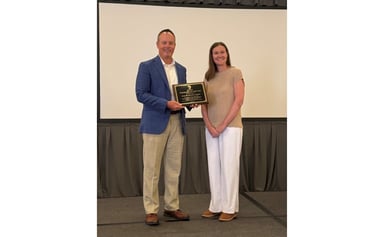
When Florida employers seek resolution of claims or controversies arising out of the Florida workers’ compensation law, they often turn to Heather. Board Certified by The Florida Bar in Workers’ Compensation, Heather leads Marshall Dennehey’s Florida workers’ compensation practice. She devotes the entirety of her practice to workers’ compensation defense, representing businesses, third-party administrators and self-insureds across myriad industries. Heather’s clients benefit from her insights and experience in dealing with the analysis and litigation of problems or controversies arising out of the Florida Workers' Compensation Law. She also has experience handling employment law matters.
Heather is an active writer and lecturer. She has authored multiple articles in the Florida Workers’ Comp Reporter. She has lectured on behalf of the Workers’ Compensation Section of The Florida Bar and at various continuing education seminars. Heather is also a Certified Instructor of Insurance Education for the State of Florida and often presents seminars to clients.
Prior to joining Marshall Dennehey, Heather was a partner at one of the leading defense firms in the southeast.
Away from work, she enjoys hiking, biking, traveling and spending time with her family. She is a committee member with the Jacksonville Humane Society, and volunteers for Jacksonville Area Legal Aid (JALA). She completed the 2008 New York City Marathon, and the National Breast Cancer Marathon, and often participates in road races that benefit various charitable organizations.
Results
Settlement Agreements Upheld in Florida Workers’ Compensation Cases
We successfully argued that a settlement agreement, based upon a binding and enforceable agreement reached via email between the parties, is enforced. The claimant had given her attorney authority to settle, but subsequently changed her mind. Based upon case law, there was unequivocal authority to settle and it was too late for the claimant to negate the agreement previously reached. The judge of compensation claims agreed and upheld the settlement. In another matter, we filed a motion to enforce a settlement agreement reached by the parties at mediation, which the judge of compensation claims granted. Despite attending mediation, reaching an agreement and having a mediation report drafted, the claimant did not sign the agreement. He then terminated the services of his attorney and retained new counsel. At the hearing held before the judge, Linda called the claimant’s former attorney as a witness and also conducted a direct examination of the claimant. Ultimately, the judge found that the claimant had agreed to settle and changed his mind later. Therefore, the settlement agreement was enforced.
Judge doesn’t buy that chemical exposure was major contributing cause for claimant’s complaints.
We won a total controvert on a workers’ compensation exposure claim and successfully defended a denial. The claimant alleged exposure to a toxic airplane paint thinner at a plant in Kentucky in December of 2019. He was a subcontractor of the airplane manufacturer, but a Florida employee. The claimant complained of breathing issues and skin rashes. He sought treatment at an emergency room in Kentucky on the date of alleged exposure ,and again approximately 10 months later for skin rashes. However, the claimant was able to continue working without any wage loss the entire time. The employer/carrier denied and defended on the basis that the claimant could not prove causation by clear and convincing evidence pursuant to F.S. 440.02. The claimant obtained an IME, which opined that his breathing issues could be attributable to the alleged exposure, but that the rashes most likely were not. The claimant’s IME physician opined that the claimant needed to undergo additional testing to determine causation. The employer/carrier’s IME opined that the major contributing cause of the claimant’s rashes and breathing issues was not the alleged exposure. The Judge of Compensation Claims accepted the employer/carrier’s IME and held that the claimant failed to prove that a workplace chemical exposure was the major contributing cause of his complaints.
Thought Leadership
Viewpoint: Florida’s New Heat Exposure Law May Impact Workers’ Comp
September 13, 2024
Florida House Bill 433, which was signed by Governor DeSantis in April and went into effect on July 1, 2024, prohibits cities and counties from requiring employers to provide their workers with shade, water breaks and other protections from hot temperatures. The law’s sponsor, Tiffany Esposito, R-District 77, explained that the goal was to prevent counties from having differing regulations. However, there are currently no laws in Florida that require heat protection for outdoor workers.
Defense Digest
Attorneys Behaving Badly: Sanctions, Attorney’s Fees and Costs in Florida Workers’ Compensation Claims
September 1, 2023
Key Points: Florida workers’ compensation law allows for sanctions. While Judges of Compensation Claims are generally hesitant to award sanctions, there are very limited circumstances where they will do so. The vast majority of the time, the Florida workers’ compensation bar is a model of professionalism. There are more than 100,000 attorneys in the state of Florida, but the workers’ compensation bar is still small enough that everyone gets to know each other after practicing for a few years. They ask about kids and families. They celebrate weddings and share vacation pictures on social media. They are empathetic and move a deposition if someone is sick. Attorneys on opposite sides are friendly when encountering one another at conferences, seminars, and Inns of Court meetings. And it’s because of this genuine congeniality that most cases move through the system without overly antagonistic litigation. But there are always a few outliers. Judges of Compensation Claims (JCC) occasionally have to struggle with how to handle repeat violators as Florida workers’ compensation law does not have a bad faith clause. So how does a JCC send a message with some teeth when an attorney is unprofessional, overly aggressive, unresponsive, or hostile? Case law from the last few years has given us some guidance on what the First District Court of Appeals has found to be within the jurisdiction of the JCCs. Florida workers’ compensation law allows for sanctions pursuant to DOAH Rule 60Q-6.125 by striking claims, petitions, defenses, and pleadings, or allowing for the imposition of costs or attorney’s fees. It also allows for other general sanctions that the JCC may deem appropriate. However, traditional F.S.57.105 sanctions that are available in civil cases are not applicable in administrative workers’ compensation claims, unless they are at an appellate level. In Mary Hektner v. School Board of Brevard County, OJCC# 13-014654RLD, 1st DCA 1D18-3792, PCA date April 15, 2019, counsel for the claimant had scheduled and noticed the adjuster’s deposition multiple times. A motion for protective order was filed and the employer/carrier’s attorney alleged that the deposition was going forward only to harass, annoy, or embarrass his adjuster and that there were very limited contested issues. The docket indicates extensive litigation and multiple issues appealed to the First District Court of Appeals. Relating to this adjuster’s live deposition, the attorney for the employer/carrier traveled from Orlando to Pompano Beach, stayed overnight in a hotel, and spent extensive time preparing the adjuster for the deposition. Counsel for the employer/carrier emailed claimant’s counsel three times and called multiple times, attempting to confirm that the deposition was going forward. Claimant’s counsel neither responded to the emails nor returned the calls. On the date of the deposition, he failed to appear in person or participate by phone. After the deposition was set to begin, claimant’s counsel’s office advised that the deposition was canceled. The employer/carrier then filed a motion for sanctions. The JCC ultimately found the circumstances warranted sanctions against claimant’s counsel only, and not the claimant. Pursuant to Florida Rules of Civil Procedure 1.310, the JCC awarded $3,661.50 for the employer/carrier attorney’s fees and $362.39 for costs. The First District Court of Appeals affirmed the decision per curiam. In a similar case, Carlos Santiago v. American Airlines, OJCC# 19-029788JIJ 1st DCA 1D20-2931 PCA date April 5, 2022, Premise, a health care provider, filed a motion for sanctions against a claimant’s attorney after the granting of a motion for protective order. The claimant’s attorney (the same attorney from the Hektner case mentioned previously) had filed a motion to compel better responses when asked to produce a contract between the defendant/employer and Premise. The employer/carrier objected on the basis of relevancy and trade secrets privilege, as it related to the workers’ compensation case. The JCC granted Premise’s motion for protective order, finding the contract was not reasonably calculated to lead to admissible evidence. The judge entered an order denying the claimant’s motion, and the claimant then filed a motion for rehearing. Premise responded by filing a motion for sanctions based upon F.S. 440.32(3), indicating that there was no good faith argument related to the modification of existing law. Additionally, Premise argued the purpose for the motion for rehearing was to harass or needlessly increase the cost of litigation. A motion for rehearing cannot re-litigate the same issue, unless there is some reversal of existing law. In this case, Premise incurred legal fees in excess of $100,000 defending this issue. The JCC found that claimant’s counsel filed the motion for rehearing for an improper purpose and that an appropriate sanction was to pay an attorney’s fee to Premise’s Health in the amount of $3,358. The district court affirmed the decision per curiam. On the other hand, in an evidentiary order on motion for sanctions in the case of Wilmer Hernandez Perez v. Seacrest Services/Travelers Insurance, OJCC #20-016176TAH dated March 2, 2023, the JCC found that it did not have enough evidence to warrant sanctions after the claimant missed four different depositions. The claimant appeared for the hearing on the motion for sanctions and testified that he was unaware of one of the dates of the deposition. Additionally, a Florida provision pursuant to DOAH Rule 60Q-6.125 provides that the party shall be served, but not filed, within 21 days of service of the motion for sanctions. This gives the allegedly offending party the ability to correct the deficiency and avoid the actual filing of the motion for sanctions. In the present case, the employer/carrier did not serve the motion on the claimant 21 days before filing it. The JCC, therefore, denied the motion for sanctions, indicating it was not a violation of the rules and the motion for sanctions was deficient. While Judges of Compensation Claims are generally hesitant to award sanctions, these cases show the (very limited) circumstances where they are pushed the edge to do so. The Florida workers’ compensation bar strives to maintain the collegial reputation that it has earned by avoiding the bad behavior outlined in the situations above and hoping that younger attorneys learn from these errors for the future. *Heather is a shareholder in our Jacksonville, Florida, office. She can be reached at 904.358.4225 or HBCarbone@mdwcg.com. Defense Digest, Vol. 29, No. 3, September 2023, is prepared by Marshall Dennehey to provide information on recent legal developments of interest to our readers. This publication is not intended to provide legal advice for a specific situation or to create an attorney-client relationship. ATTORNEY ADVERTISING pursuant to New York RPC 7.1. © 2023 Marshall Dennehey. All Rights Reserved. This article may not be reprinted without the express written permission of our firm. For reprints, contact tamontemuro@mdwcg.com.