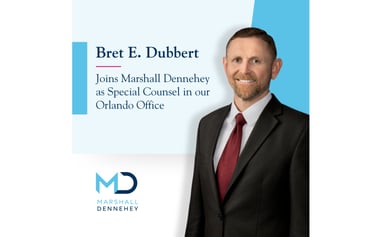
Brendan is a member of the Professional Liability Department where he focuses his practice on the defense of auto manufacturers in all stages of their warranty litigation from pre-suit, arbitration and jury trials. Additionally, he represents insurance carriers in coverage disputes and alleged bad faith actions. Many of the coverage disputes involves windstorm claims, interior water damage claims, mold claims and remediation claims.
Brendan started his career as a public defender in Miami-Dade County, where he gained extensive courtroom and trial experience. He later went on to work at a civil defense firm where he eventually became a named partner. While there, he defended many major American and European automotive companies in both state and federal court, as well as at the administrative level. Brendan has tried cases throughout the state of Florida on behalf of his clients.
Brendan received his Juris Doctorate from Saint Thomas University and his Bachelor of Arts in English from the College of William and Mary.
Thought Leadership
Legal Updates for Florida Coverage and Property Litigation
Appeals Court Reverses Trial Court Order Awarding Attorney’s Fees Due to Lack of Evidence to Support Fee Awarded
October 5, 2026
The Fourth District Court of Appeal reversed the trial court’s order awarding appellate fees to People’s Trust Insurance Company based upon a lack of evidence to support the attorney’s fee award in RM & Assocs. Consulting, Inc. v. People's Trust Ins. Co., 2026 Fla. App. LEXIS 4654 (Fla. 4th DCA 2026). People’s Trust was the insurer of a residential property that had sustained water damage. RM & Associates Consulting was hired by the homeowner to perform mitigation services at the property. The homeowner assigned post-loss benefits to RM and RM subsequently filed suit against People’s Trust alleging that it had not been paid the money it was owed for the mitigation services. People’s Trust defended the lawsuit on the ground that the policy required the insured to notify the insurer before authorizing repairs so People's Trust could elect to use its preferred contractor. Because the owner did not comply with that provision, People's Trust asserted its liability was limited to the amount that its preferred contractor would have charged for the work, which People's Trust contended was $2,000. People's Trust paid that amount to RM before RM filed suit. People’s Trust filed a motion for summary judgment which was granted. RM appealed the summary judgment ruling and the ruling was upheld by the Fourth District Court of Appeal. The appellate court also granted People’s Trust’s entitlement to appellate attorney’s fees, subject to the trial court’s determination of the amount of fees, based upon an offer of judgment made by People's Trust. On remand, the trial court held an evidentiary hearing to determine the amount of attorney’s fees People’s Trust was entitled to. At the hearing, People’s Trust presented testimony from it’s fee expert, supervising trial counsel and appellate counsel. People’s Trust sought recovery of $24,866.17 for work performed by appellate counsel. The request primarily consisted of work performed in preparation of the answer brief. The fee expert testified that more than ninety hours spent preparing the answer brief was reasonable given the complexity and significance of the underlying issue. The appellate court found that the fee expert’s testimony fell short of meeting the necessary standard of demonstrating that the hours expended were necessary. The appellate court found that the billing records did not serve to cure the deficient testimony, as the billing records did not contain adequate details regarding the specific tasks performed. Rather the records contained entries such as “answer brief” which the appellate court found to be insufficient. The appellate court noted that neither the fee expert or counsel addressed how the prior research and briefing in the parallel litigation informed the work in the instant matter. The appellate court noted this was significant in that a court's attorney's fees award must exclude excessive, redundant, or otherwise unnecessary hours, citing Florida Patient's Compensation Fund v. Rowe, 472 So. 2d 1145 (Fla. 1985). Based upon the record failing to support the finding of the trial court, the 4th DCA remanded the case to the trial court for a reconsideration and redetermination of reasonable appellate attorney’s fees supported by competent substantial evidence. The 4th DCA reiterated that the fee expert’s focus on the quality of the work and the importance of the work to People’s Trust did not make up for the perceived deficiencies in the position that spending over ninety hours on a single answer brief was reasonable. Whether moving for attorney’s fees or challenging the amount of fees being sought by an opposing party, practitioners should be mindful of the evidence being used to support the claims being made. Parties should pay close attention to whether the hours being sought may be impacted by prior litigation either party may have engaged in. A party must be prepared to address how prior litigation efforts did or did not impact the amount of hours being claimed in current litigation. Lastly, billing records must be sufficiently detailed so as to support any potential future fee claim.
Legal Updates for Florida Coverage and Property Litigation
Appeals Court Reverses Trial Court Order Striking Complaint as Sanction for Violating Discovery Order
June 11, 2026
All Dry USA v. Savell, 2026 WL 816093 (Fla. 1st DCA 2026) The First District Court of Appeal reversed the trial court’s order denying All Dry USA’s complaint as a sanction for violating a discovery order. The appellate court found that All Dry USA’s failure to comply with the trial court’s case management order did not give the trial court the authority to strike All Dry USA’s pleadings. All Dry USA provided water mitigation, mold remediation, and a restorative tarp at the property owned by the Savells. The property had been damaged by Hurricane Sally. All Dry USA provided invoices for the three services it performed in the amount of $90,130.61. The Savells refused to pay the invoices, stating that while they had retained All Dry USA, there was no agreement reached regarding the cost of the services. All Dry USA proceeded to file a lawsuit against the Savells, alleging breach of contract and unjust enrichment. The Savells answered the lawsuit and served discovery upon All Dry USA. All Dry USA failed to respond to the discovery requests and the Savells moved for an order compelling discovery. The trial court issued an order compelling All Dry USA to respond to Savells discovery requests and comply with all outstanding discovery deadlines per the case management order. On the day its responses were due, All Dry USA filed a motion to extend the deadline to comply with the court’s order. Before the motion was ruled upon, the Savells filed a motion to have All Dry USA’s complaint stricken for violating the trial court’s order compelling All Dry USA’s responses. The trial court granted the motion to strike, and then granted the Savell’s request for entry of default final judgment, based upon there no longer being an operative complaint. The First District Court of Appeal reversed, ruling that an order striking pleadings is justified if it is found that a party has violated numerous discovery orders, or has shown a “deliberate and contumacious disregard of the court's authority.” Mercer v. Raine, 443 So. 2d 944, 946 (Fla. 1983). The appellate court stated that a trial court’s authority to strike pleadings is not unbridled and that the situation before the court did not justify the striking of All Dry USA’s pleadings. In reaching its decision, the First District focused on the fact that the trial court only addressed the potential prejudice to Savell by All Dry USA failing to respond to discovery and seeking an extension of the deadline. The appellate court stated that prejudice is not the only factor to be considered and that the trial court needed to address if All Dry USA’s behavior in failing to comply with the discovery order was willful and deliberate. The First District also stated that nothing in rule 1.200 or 1.380 grants a trial court the authority to strike a pleading because certain case management deadlines are not met. The appellate court held that the Florida Rules of Civil Procedure allow trial courts to bring the parties in, order them to comply with the case management discovery deadlines, and then strike pleadings if the subsequent discovery orders are disobeyed. This ruling shows the importance of understanding the authority that is binding on the trial court a party is appearing in front of. The First District’s view on a trial court’s ability to strike pleadings is in contrast with other appellate court’s throughout Florida.